Wednesday, April 29, 2020

I recorded YOU masturbating! I have .mp4 video file!

ATTENTION:

The last time you visited a porn website with teenagers, you
silently downloaded and installed the software I developed.

My software has turned on your camera and recorded both your
screen and the act of your masturbation.

My sneaky program also downloaded all your email contact lists
and list of your friends from social networks.

I have the - .mp4 video file - with you jerking off, as well as
a file with your relatives and associates email addresses.

After downloading those files let me say one thing: your
fantasies are far beyond the normal!


If you want me to delete both files and keep your secret, you
must send me the Bitcoin (BTC) payment.
I give you 72 hours only to send the Bitcoin transfer.

If you don't know how to pay with Bitcoin, visit Google and
search - how to buy Bitcoin (BTC).
Visit one of the brokers (www.Coinbase.com, www.coinmama.com,
www.kucoin.com, Bitstamp, anycoindirect), buy Bitcoin and send it
to my address.
Only then I will leave you alone!

At anycoindirect you can buy Bitcoin instantly with SEPA,
Giropay, EPS, Mybank, Sofort, credit cards or Bancontract.

Here are the payment details:


Send 5,000 USD = 0.590364 BTC to this Bitcoin address below asap:

16ygC4VX8tKBAW8syKT36YxeGhKaZSkKec

(copy & paste address - it's case sensitive)


Send exactly 0.990364 BTC to my Bitcoin wallet.


As soon as you open this Email I will be notified you opened it.
I am monitoring all actions on your device..

This Bitcoin address is linked to you only, so I will know
immediately when you send the correct amount.
When you pay in full, I will remove both files (your
masturbation video and your contact lists) and I will deactivate
my sneaky program.
Changing your password will not help you; I will still have
access to your device remotely.

If you choose not to send me the Bitcoin transfer,I will send
your masturbation video to all your friends and associates from
your contact lists and social media that I downloaded from your
device.
Your family members will receive it as well. You will regret it,
trust me.

Here are the payment details again:


Send 5,000 USD = 0.990364 BTC to this Bitcoin address below as
soon as possible:

16ygC4VX8tKBAW8syKT36YxeGhKaZSkKec

(copy & paste address - it's case sensitive)


You can visit the police but they will not solve your real
problem.
My program will still be installed on your device and I still
will own your masturbation videos.
Police will not catch me anyway. I know what I am doing. I do
not live in your country and I know how to stay anonymous.

My program is recording all the websites you visit and all your
key presses. If you try not to follow my instructions - I will
send this ugly video to everyone you know, including your family
members.

Don't forget the potential shame - your life can be a disaster!

subject: Decrypt-APP-000097-7226HP
After these steps you will receive through email the key and a
decrypt tutorial.

I am waiting for your Bitcoin payment.
You have 72 hours left.

Saturday, April 25, 2020

TOP 10 HACKING MOVIES YOU SHOULD WATCH

Technology and hacking gave a new horizon to the science fiction movies. As hacking is getting common and every online thing is at risk whether it's 10% or 90%, not a system is 100% secure over the internet. Every day new security holes are getting discovered. So, now most of the sci-fi movies have the tech and hack stuff to grow awareness in everybody's mind about the online privacy and risk to their information. Here I am sharing top 10 hacking movies that worth a watch.

TOP 10 HACKING MOVIES

Here I have listed top 10 hacking movies that you should watch.

1. HACKERS (1995)

In Hackers, Angelina Jolie and Jonny Lee Miller portray two youthful and hip hackers. Miller portrays a hacker who got caught as a very young child at an age of 11 years after crashing thousands of computers and has been sentenced to zero computer access until his 18th birthday.

2. LIVE FREE OR DIE HARD (2007)

Live Free or Die Hard (also known as Die Hard 4 and released as Die Hard 4.0 outside North America) is a 2007 American action film, and the fourth in the Die Hard film series depicts a scenario where a hacker played by Timothy Olyphant (of Justified fame) takes down nearly the entire U.S. infrastructure in an attempt to transfer trillions of dollars from the Federal Reserve to his account. This movie gives a complete idea of how actually these blackhat hackers operate.

3. EAGLE EYE (2008)

In this movie, two people get a call from an unknown number by a woman. They get a task on the phone that if they don't follow the phone call they would die. This movie displays supercomputer hack on all networks and military networks. This is just an amazing movie on how artificial intelligence computer hacks our real life for bad motives.

4. ALGORITHM (2014)

The film 'Algorithm' tracks the travails of Will, who is the freelance computer hacker who hacks into a top-secret government contractor agency and downloads all their recently developed programs." You can see the full movie below

5. WARGAMES (1983)

The film features David Lightman (Broderick), a young high school student hacker who accidentally hacks into a military supercomputer and starts the countdown to World War III.

6. THE MATRIX (1999)

This is one of the greatest science fiction movies. In this movie, reality, as perceived by most humans, is actually a simulated reality called "the Matrix", created by machines to subdue the human population, while their bodies' heat and electrical activity are used as an energy source.
A character named "Neo", who is a computer Hacker, learns this truth and is drawn into a rebellion against the machines, which involves other people who have been freed from the "dream world". The Matrix franchise is a trilogy movie series.

7. TAKEDOWN (2000)

This movie is based on famous computer U.S. hacker Kevin David Mitnick. Based upon the book and written by his nemesis, Tsutomu Shimomura, the story tends to glorify Shimomura. Mitnick operated in the 1980s and '90s and eventually went to prison for a couple of years. Now, he is a highly paid IT security consultant, speaker, and writer.

8. BLACKHAT (2015)

Blackhat is newly released movie by Chris Hemsworth. In this movie, hackers hack the Chinese nuclear power plant to start a nuclear reaction. Simultaneously, they also hack the stock exchange and steal millions of dollars from the bank. This movie shows how a black hat hackers threaten governments.

9. THE ITALIAN JOB (2003)

Although the MINI Coopers are really the stars of The Italian Job (a remake of the 1969 film of the same name), Seth Green plays Lyle, a hacker among a group of elite thieves, who is able to manipulate traffic signals, among other devices, that make this grand theft possible.

10. UNTRACEABLE (2008)

This film involves a serial killer who rigs contraptions that kill his victims based on the number of hits received by a website KillWithMe.com that features a live streaming video of the victim. Millions of people log on, hastening the victims' deaths.

There may be more exciting hacking movies but I found these top 10 hacking movies that you should watch for once.
You can also find out the top 5 most dangerous hackers in the real world living.

Related news


  1. Social Hacking
  2. Hacking Web Sql Injection
  3. Que Es El Hacking
  4. Curso De Hacking Etico Gratis
  5. Hacking Background
  6. Hacking Con Buscadores Pdf
  7. Hacking Net
  8. Ingeniería Social. El Arte Del Hacking Personal Pdf
  9. Growth Hacking Definicion
  10. Body Hacking

goGetBucket - A Penetration Testing Tool To Enumerate And Analyse Amazon S3 Buckets Owned By A Domain


When performing a recon on a domain - understanding assets they own is very important. AWS S3 bucket permissions have been confused time and time again, and have allowed for the exposure of sensitive material.

What this tool does, is enumerate S3 bucket names using common patterns I have identified during my time bug hunting and pentesting. Permutations are supported on a root domain name using a custom wordlist. I highly recommend the one packaged within AltDNS.

The following information about every bucket found to exist will be returned:
  • List Permission
  • Write Permission
  • Region the Bucket exists in
  • If the bucket has all access disabled

Installation
go get -u github.com/glen-mac/goGetBucket

Usage
goGetBucket -m ~/tools/altdns/words.txt -d <domain> -o <output> -i <wordlist>
Usage of ./goGetBucket:
-d string
Supplied domain name (used with mutation flag)
-f string
Path to a testfile (default "/tmp/test.file")
-i string
Path to input wordlist to enumerate
-k string
Keyword list (used with mutation flag)
-m string
Path to mutation wordlist (requires domain flag)
-o string
Path to output file to store log
-t int
Number of concurrent threads (default 100)
Throughout my use of the tool, I have produced the best results when I feed in a list (-i) of subdomains for a root domain I am interested in. E.G:
www.domain.com
mail.domain.com
dev.domain.com
The test file (-f) is a file that the script will attempt to store in the bucket to test write permissions. So maybe store your contact information and a warning message if this is performed during a bounty?
The keyword list (-k) is concatenated with the root domain name (-d) and the domain without the TLD to permutate using the supplied permuation wordlist (-m).
Be sure not to increase the threads too high (-t) - as the AWS has API rate limiting that will kick in and start giving an undesired return code.

Related links
  1. Arduino Hacking
  2. Capture The Flag Hacking
  3. Google Hacking
  4. Hacking To The Gate
  5. Hacking Day
  6. Hacking Udemy
  7. Como Ser Hacker
  8. Hacking Etico
  9. Growth Hacking Examples

A Quick Guide To Selection Sorting


In this Article I'll tell you about Selection Sort
Selection sort is that type of sorting in which smallest element of a list is searched and then this number is swapped with the first element of the list and then second smallest element is searched in the list and is swapped with the second element of the list and so on i,e this "thingy" thing continues on till n-1 times (where 'n' is the number of terms).
COMPLEXITY:-
Complexity of Selection sort is O(n^2) in best case as well as in worst case.

Well selection sort is not a good sorting algorithm which you can see even from the complexity of selection sort because selection sort performs same number of comparisons even in the best case as in the worst case. Which makes it very slow.
Pseudo-code:-
sort(Arr)
for i = 0 to n-1
smallest = location of smallest number from Arr[i] to Arr[n-1]
swap Arr[i] with Arr[smallest]

/*C Program: Implementation of Selection Sort*/
#include<stdio.h>
void swap(int a[], int i, int j){
    int tmp = a[i];
    a[i] = a[j];
    a[j] = tmp;
}
void selectionSort(int a[], int l, int h){
   for(int i=l; i<h; i++){
     int small  = i;
     for(int j=i+1; j<=h; j++){
       if(a[j] < a[i]) small = j;
     }
     swap(a,i,small);
   }
}
int main(void) {
   int arr[10], n;
   printf("Enter Size of Array: ");
   scanf("%d", &n);
   printf("Enter %d elements:\n", n);
   for(int i=0; i<n; i++) scanf("%d", &arr[i]);
   selectionSort(arr, 0, n-1);
   printf("Sorted Array is as:\n");
   for(int i=0; i<n; i++) printf("%d ", arr[i]);
   printf("\n");
   return 0;
}
Related news

CEH: Fundamentals Of Social Engineering


Social engineering is a nontechnical method of breaking into a system or network. It's the process of deceiving users of a system and convincing them to perform acts useful to the hacker, such as giving out information that can be used to defeat or bypass security mechanisms. Social engineering is important to understand because hackers can use it to attack the human element of a system and circumvent technical security measures. This method can be used to gather information before or during an attack.

A social engineer commonly uses the telephone or Internet to trick people into revealing sensitive information or to get them to do something that is against the security policies of the organization. By this method, social engineers exploit the natural tendency of a person to trust their word, rather than exploiting computer security holes. It's generally agreed that users are the weak link in security; this principle is what makes social engineering possible.

The most dangerous part of social engineering is that companies with authentication processes, firewalls, virtual private networks, and network monitoring software are still wide open to attacks, because social engineering doesn't assault the security measures directly. Instead, a social-engineering attack bypasses the security measures and goes after the human element in an organization.

Types of Social Engineering-Attacks

There are two types of Social Engineering attacks

Human-Based 

Human-based social engineering refers to person-to-person interaction to retrieve the desired information. An example is calling the help desk and trying to find out a password.

Computer-Based 

​Computer-based social engineering refers to having computer software that attempts to retrieve the desired information. An example is sending a user an email and asking them to reenter a password in a web page to confirm it. This social-engineering attack is also known as phishing.

Human-Based Social Engineering

Human-Based further categorized as follow:

Impersonating an Employee or Valid User

In this type of social-engineering attack, the hacker pretends to be an employee or valid user on the system. A hacker can gain physical access by pretending to be a janitor, employee, or contractor. Once inside the facility, the hacker gathers information from trashcans, desktops, or computer systems.

Posing as an Important User

In this type of attack, the hacker pretends to be an important user such as an executive or high-level manager who needs immediate assistance to gain access to a computer system or files. The hacker uses intimidation so that a lower-level employee such as a help desk worker will assist them in gaining access to the system. Most low-level employees won't question someone who appears to be in a position of authority.

Using a Third Person

Using the third-person approach, a hacker pretends to have permission from an authorized source to use a system. This attack is especially effective if the supposed authorized source is on vacation or can't be contacted for verification.

Calling Technical Support

Calling tech support for assistance is a classic social-engineering technique. Help desk and technical support personnel are trained to help users, which makes them good prey for social-engineering attacks.

Shoulder Surfing 

Shoulder surfing is a technique of gathering passwords by watching over a person's shoulder while they log in to the system. A hacker can watch a valid user log in and then use that password to gain access to the system.

Dumpster Diving

Dumpster diving involves looking in the trash for information written on pieces of paper or computer printouts. The hacker can often find passwords, filenames, or other pieces of confidential information.

Computer-Based Social Engineering

Computer-based social-engineering attacks can include the following:
  • Email attachments
  • Fake websites
  • Pop-up windows


Insider Attacks

If a hacker can't find any other way to hack an organization, the next best option is to infiltrate the organization by getting hired as an employee or finding a disgruntled employee to assist in the attack. Insider attacks can be powerful because employees have physical access and are able to move freely about the organization. An example might be someone posing as a delivery person by wearing a uniform and gaining access to a delivery room or loading dock. Another possibility is someone posing as a member of the cleaning crew who has access to the inside of the building and is usually able to move about the offices. As a last resort, a hacker might bribe or otherwise coerce an employee to participate in the attack by providing information such as passwords.

Identity Theft

A hacker can pose as an employee or steal the employee's identity to perpetrate an attack. Information gathered in dumpster diving or shoulder surfing in combination with creating fake ID badges can gain the hacker entry into an organization. Creating a persona that can enter the building unchallenged is the goal of identity theft.

Phishing Attacks

Phishing involves sending an email, usually posing as a bank, credit card company, or other financial organization. The email requests that the recipient confirm banking information or reset passwords or PINs. The user clicks the link in the email and is redirected to a fake website. The hacker is then able to capture this information and use it for financial gain or to perpetrate other attacks. Emails that claim the senders have a great amount of money but need your help getting it out of the country are examples of phishing attacks. These attacks prey on the common person and are aimed at getting them to provide bank account access codes or other confidential information to the hacker.

Online Scams

Some websites that make free offers or other special deals can lure a victim to enter a username and password that may be the same as those they use to access their work system.
The hacker can use this valid username and password once the user enters the information in the website form. Mail attachments can be used to send malicious code to a victim's system, which could automatically execute something like a software keylogger to capture passwords. Viruses, Trojans, and worms can be included in cleverly crafted emails to entice a victim to open the attachment. Mail attachments are considered a computer-based social-engineering attack.

Related news


One Reason Why InfoSec Sucked In The Past 20 Years - The "Security Tips" Myth

From time to time, I get disappointed how much effort and money is put into securing computers, networks, mobile phones, ... and yet in 2016 here we are, where not much has changed on the defensive side. There are many things I personally blame for this situation, and one of them is the security tips.

The goal of these security tips is that if the average user follows these easy to remember rules, their computer will be safe. Unfortunately, by the time people integrate these rules into their daily life, these rules either become outdated, or these rules were so oversimplified that it was never true in the first place. Some of these security tips might sound ridiculous to people in InfoSec nowadays, but this is exactly what people still remember because we told them so for years.

PDF is safe to open

This is an oldie. I think this started at the time of macro viruses. Still, people think opening a PDF from an untrusted source is safer than opening a Word file. For details why this is not true, check: https://www.cvedetails.com/vulnerability-list/vendor_id-53/product_id-497/Adobe-Acrobat-Reader.html
On an unrelated note, people still believe PDF is integrity protected because the content cannot be changed (compared to a Word document).
Image stolen from Kaspersky

Java is secure

One of the best ones. Oracle started marketing Java as a safe language, where buffer overflows, format strings and pointer-based vulnerabilities are gone. Unfortunately, they forgot to tell the world that instead of "unsafe programs developed by others" they installed their unsafe program on 3 billion devices. 

Stay away from rogue websites and you will be safe

This is a very common belief I hear from average people. "I only visit some trusted news sites and social media, I never visit those shady sites." I have some bad news. At the time of malvertising and infected websites, you don't have to visit those shady sites anymore to get infected.

Don't use open WiFi

I have a very long explanation of why this makes no sense, see here. Actually, the whole recommendation makes no sense as people will connect to public WiFis, no matter what we (InfoSec) recommend.

The password policy nightmare

Actually, this topic has been covered by myself in two blog posts, see here and here. Long story short: use a password manager and 2-factor authentication wherever possible. Let the password manager choose the password for you. And last but not least, corporate password policy sux.

Sites with a padlock are safe

We tell people for years that the communication with HTTPS sites are safe, and you can be sure it is HTTPS by finding a randomly changing padlock icon somewhere next to the URL. What people hear is that sites with padlocks are safe. Whatever that means. The same goes for WiFi - a network with a padlock is safe.

Use Linux, it is free from malware

For years people told to Windows users that only if they would use Linux they won't have so much malware. Thanks to Android, now everyone in the world can enjoy malware on his/her Linux machine.

OSX is free from malware

It is true that there is significantly less malware on OSX than on Windows, but this is an "economical" question rather than a "security" one. The more people use OSX, the better target it will become. Some people even believe they are safe from phishing because they are using a Mac!

Updated AV + firewall makes me 100% safe

There is no such thing as 100% safe, and unfortunately, nowadays most malware is written for PROFIT, which means it can bypass these basic protections for days (or weeks, months, years). The more proactive protection is built into the product, the better!

How to backup data

Although this is one of the most important security tips which is not followed by people, my problem here is not the backup data advise, but how we as a community failed to provide easy to use ways to do that. Now that crypto-ransomware is a real threat to every Windows (and some OSX) users, even those people who have backups on their NAS can find their backups lost. The only hope is that at least OSX has Time Machine which is not targeted yet, and the only backup solution which really works.
The worst part is that we even created NAS devices which can be infected via worms ...

Disconnect your computer from the Internet when not used

There is no need to comment on this. Whoever recommends things like that, clearly has a problem.

Use (free) VPN to protect your anonimity

First of all. There is no such thing as free service. If it is free, you are the service. On another hand, a non-free VPN can introduce new vulnerablities, and they won't protect your anonymity. It replaces one ISP with another (your VPN provider). Even TOR cannot guarantee anonymity by itself, and VPNs are much worse.

The corporate "security tips" myth

"Luckily" these toxic security tips have infected the enterprise environment as well, not just the home users.

Use robots.txt to hide secret information on public websites

It is 2016 and somehow web developers still believe in this nonsense. And this is why this is usually the first to check on a website for penetration testers or attackers.

My password policy is safer than ever

As previously discussed, passwords are bad. Very bad. And they will stick with us for decades ...

Use WAF, IDS, IPS, Nextgen APT detection hibber-gibber and you will be safe

Companies should invest more in people and less into magic blinking devices.

Instead of shipping computers with bloatware, ship computers with exploit protection software
Teach people how to use a password safe
Teach people how to use 2FA
Teach people how to use common-sense

Conclusion

Computer security is complex, hard and the risks change every year. Is this our fault? Probably. But these kinds of security tips won't help us save the world. 

More info


Friday, April 24, 2020

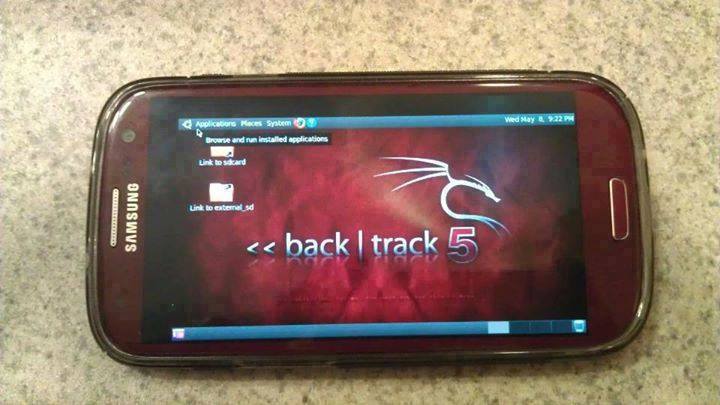
How To Install And Run Backtrack On Android

Guide you step by step to How to install and run Backtrack on android. As the Backtrack is also available with ARM architecture which makes it possible to run Backtrack on an ARM machine such as mobiles or tablets.
Recently, We are discussed Install and Run BackTrack on Windows. Android is the best OS for penetration testing. It designed for digital forensics and penetration testing or hacking tool. It comes with many more updated tools. As the Backtrack is also available with ARM architecture which makes it possible to run Backtrack on an ARM machine such as mobiles or tablets.
How To Install and Run Backtrack On AndroidRequirements
Step to Install and Run Backtrack On Android:
First of all extract the BT5-GNOME-ARM.7z. and copy the "BT5" folder and then put in your phone's root directory. Here mine phone is /sdcard. The root directory is different for different mobile devices.
  • Now install all the above apps BusyboxAndroid TerminalAndroid Vnc.
  • After installing BusyBox application open it and wait until it finishes loading and then click on Smart install.
  • Now open the android terminal and type the following command:
    su cd /sdcard/BT5sh bootbtNOTE :- When you type su in terminal it will ask you for superuser request and you have to tap on Grant.
  • After this, type the following commands in terminal.
    export USER=rootvncpasswd
  • After entering vncpasswd the terminal will ask you to enter the password. Enter the desired password and hit enter.
  • Now type the following commands.
    tightvncserver -geometry 1280×720
  • The terminal emulator will create the localhost to connect it to VNC server. Now note the localhost port marked red below. Now minimize the terminal emulator.
  • Open the Android VNC and type the following settings.
Nickname : BT5
Password : your password here which you entered in terminal (step no.6)
Address : localhost
Port : 5906
NOTE: Make sure that your localhost's port matches with terminal's localhost. Here mine New 'X' desktop is localhost:6. You may be different. So, in VNC type Port 590X where the "X" is the localhost in the android terminal.
That's it now just tap on connect to run the Backtrack on your android. So in this way you successfully install and run backtrack 5 on android. If you face any problem feel free to discuss in below comments!
Related word

Thursday, April 23, 2020

Cain And Abel

"Cain & Abel is a password recovery tool for Microsoft Operating Systems. It allows easy recovery of various kind of passwords by sniffing the network, cracking encrypted passwords using Dictionary, Brute-Force and Cryptanalysis attacks, recording VoIP conversations, decoding scrambled passwords, recovering wireless network keys, revealing password boxes, uncovering cached passwords and analyzing routing protocols. The program does not exploit any software vulnerabilities or bugs that could not be fixed with little effort. It covers some security aspects/weakness present in protocol's standards, authentication methods and caching mechanisms; its main purpose is the simplified recovery of passwords and credentials from various sources, however it also ships some "non standard" utilities for Microsoft Windows users." read more...

Website: http://www.oxid.it/cain.html

Read more


  1. Curso De Hacking Etico Gratis
  2. Hacking Live
  3. Herramientas Hacking Android
  4. Hacking Day

Wednesday, April 22, 2020

LEGALITY OF ETHICAL HACKING

Why ethical hacking?
Legality of Ehical Hacking
 
Ethical hacking is legal if the hacker abides by the rules stipulated in above section on the definition of ethical hacking.

Ethical hacking is not legal for black hat hackers.They gain unauthorized access over a computer system or networks for money extortion.

Related word


Linux.Agent Malware Sample - Data Stealer


Research: SentinelOne, Tim Strazzere Hiding in plain sight?
Sample credit: Tim Strazzere


List of files

9f7ead4a7e9412225be540c30e04bf98dbd69f62b8910877f0f33057ca153b65  malware
d507119f6684c2d978129542f632346774fa2e96cf76fa77f377d130463e9c2c  malware
fddb36800fbd0a9c9bfffb22ce7eacbccecd1c26b0d3fb3560da5e9ed97ec14c  script.decompiled-pretty
ec5d4f90c91273b3794814be6b6257523d5300c28a492093e4fa1743291858dc  script.decompiled-raw
4d46893167464852455fce9829d4f9fcf3cce171c6f1a9c70ee133f225444d37  script.dumped

malware_a3dad000efa7d14c236c8018ad110144
malware fcbfb234b912c84e052a4a393c516c78
script.decompiled-pretty aab8ea012eafddabcdeee115ecc0e9b5
script.decompiled-raw ae0ea319de60dae6d3e0e58265e0cfcc
script.dumped b30df2e63bd4f35a32f9ea9b23a6f9e7


Download


Download. Email me if you need the password

Related links

Researcher Discloses 4 Zero-Day Bugs In IBM's Enterprise Security Software

A cybersecurity researcher today publicly disclosed technical details and PoC for 4 unpatched zero-day vulnerabilities affecting an enterprise security software offered by IBM after the company refused to acknowledge the responsibly submitted disclosure. The affected premium product in question is IBM Data Risk Manager (IDRM) that has been designed to analyze sensitive business information

via The Hacker NewsRelated links
  1. Hacking Youtube
  2. Programas Para Hackear
  3. What Is Growth Hacking
  4. Hacking Libro
  5. Hacking Tutorials
  6. Grey Hat Hacking
  7. Hacking Significado
  8. Hacking Wifi Kali Linux
  9. Hacking Windows: Ataques A Sistemas Y Redes Microsoft
  10. Libro Hacker

Tuesday, April 21, 2020

Thousand Ways To Backdoor A Windows Domain (Forest)

When the Kerberos elevation of privilege (CVE-2014-6324 / MS14-068) vulnerability has been made public, the remediation paragraph of the following blog post made some waves:
http://blogs.technet.com/b/srd/archive/2014/11/18/additional-information-about-cve-2014-6324.aspx

"The only way a domain compromise can be remediated with a high level of certainty is a complete rebuild of the domain."

Personally, I agree with this, but .... But whether this is the real solution, I'm not sure. And the same applies to compromised computers. When it has been identified that malware was able to run on the computer (e.g. scheduled scan found the malware), there is no easy way to determine with 100% certainty that there is no rootkit on the computer. Thus rebuilding the computer might be a good thing to consider. For paranoids, use new hardware ;)

But rebuilding a single workstation and rebuilding a whole domain is not on the same complexity level. Rebuilding a domain can take weeks or months (or years, which will never happen, as the business will close before that).

There are countless documented methods to backdoor a computer, but I have never seen a post where someone collects all the methods to backdoor a domain. In the following, I will refer to domain admin, but in reality, I mean Domain Admins, Enterprise Admins, and Schema Admins.


Ways to backdoor a domain

So here you go, an incomplete list to backdoor a domain:

  • Create a new domain admin user. Easy to do, easy to detect, easy to remediate
  • Dump password hashes. The attacker can either crack those or just pass-the-hash. Since KB2871997, pass-the-hash might be trickier (https://technet.microsoft.com/library/security/2871997), but not impossible. Easy to do, hard to detect, hard to remediate - just think about service user passwords. And during remediation, consider all passwords compromised, even strong ones.
  • Logon scripts - modify the logon scripts and add something malicious in it. Almost anything detailed in this post can be added :D
  • Use an already available account, and add domain admin privileges to that. Reset its password. Mess with current group memberships - e.g. http://www.exploit-db.com/papers/17167/
  • Backdoor any workstation where domain admins login. While remediating workstations, don't forget to clean the roaming profile. The type of backdoor can use different forms: malware, local admin, password (hidden admin with 500 RID), sticky keys, etc.
  • Backdoor any domain controller server. For advanced attacks, see Skeleton keys 
  • Backdoor files on network shares which are commonly used by domain admins by adding malware to commonly used executables - Backdoor factory
  • Change ownership/permissions on AD partitions - if you have particular details on how to do this specifically, please comment
  • Create a new domain user. Hide admin privileges with SID history. Easy to do, hard to detect, easy to remediate - check Mimikatz experimental for addsid
  • Golden tickets - easy to do, hard to detect, medium remediation
  • Silver tickets - easy to do, hard to detect, medium/hard remediation
  • Backdoor workstations/servers via group policy
    • HKEY_LOCAL_MACHINE\ Software\ Microsoft\ Windows\ CurrentVersion\ RunOnce,
    • scheduled tasks (run task 2 years later),
    • sticky-keys with debug
  • Backdoor patch management tool, see slides here
[Update 2017.01.10]


Other tricks

The following list does not fit in the previous "instant admin" tips, but still, it can make the attackers life easier if their primary foothold has been disabled:

  • Backdoor recent backups - and when the backdoor is needed, destroy the files, so the files will be restored from the backdoored backup
  • Backdoor the Exchange server - get a copy of emails
  • Backdoor workstation/server golden image
  • Change permission of logon scripts to allow modification later
  • Place malicious symlinks to file shares, collect hashes via SMB auth tries on specified IP address, grab password hashes later
  • Backdoor remote admin management e.g. HP iLO - e.g. create new user or steal current password
  • Backdoor files e.g. on shares to use in SMB relay
  • Backdoor source code of in-house-developed software
  • Use any type of sniffed or reused passwords in new attacks, e.g. network admin, firewall admin, VPN admin, AV admin, etc.
  • Change the content of the proxy pac file (change browser configuration if necessary), including special exception(s) for a chosen domain(s)  to use proxy on malicious IP. Redirect the traffic, enforce authentication, grab password hashes, ???, profit.
  • Create high privileged users in applications running with high privileges, e.g. MSSQL, Tomcat, and own the machine, impersonate users, grab their credentials, etc. The typical pentest path made easy.
  • Remove patches from servers, change patch policy not to install those patches.
  • Steal Windows root/intermediate CA keys
  • Weaken AD security by changing group policy (e.g. re-enabling LM-hashes)
Update [2015-09-27]: I found this great presentation from Jakob Heidelberg. It mentions (at least) the following techniques, it is worth to check these:
  • Microsoft Local Administrator Password Solution
  • Enroll virtual smart card certificates for domain admins

Forensics

If you have been chosen to remediate a network where attackers gained domain admin privileges, well, you have a lot of things to look for :)

I can recommend two tools which can help you during your investigation:

Lessons learned

But guess what, not all of these problems are solved by rebuilding the AD. One has to rebuild all the computers from scratch as well. Which seems quite impossible. When someone is creating a new AD, it is impossible not to migrate some configuration/data/files from the old domain. And whenever this happens, there is a risk that the new AD will be backdoored as well.

Ok, we are doomed, but what can we do? I recommend proper log analysis, analyze trends, and detect strange patterns in your network. Better spend money on these, than on the domain rebuild. And when you find something, do a proper incident response. And good luck!

Ps: Thanks to Andrew, EQ, and Tileo for adding new ideas to this post.

Check out the host backdooring post as well! :)
Related links
  1. Escuela De Hacking
  2. Herramientas Hacking Etico
  3. Herramientas Hacking Android
  4. Programa De Hacking
  5. Programa De Hacking

Monday, April 20, 2020

How To Create Fake Email Address Within Seconds

How To Create Fake Email Address Within Seconds

How To Create Fake Email Address Within Seconds

Email address is a type of identification by which an email receiver identifies the person who sends mail to him/her. That's why while creating an email address you need to enter your personal details that must be valid. However, what if we tell you that you can create an email address that doesn't require any validation of personal details and that email address gets permanently deleted after your work is done. So here we have a method To Create Fake Email Address. By this, you can create a fake email address that will get auto-deleted after ten minutes. Just follow the below steps to proceed.

Note:  The method we are discussing is just for a known purpose and should not be used for any illegal purposes, as we will be not responsible for any wrongdoing.

How To Create Fake Email Address Within Seconds

The method of creating a fake email address is very simple and easy as these are based on online websites that will provide you a free email address without taking any personal details from you.

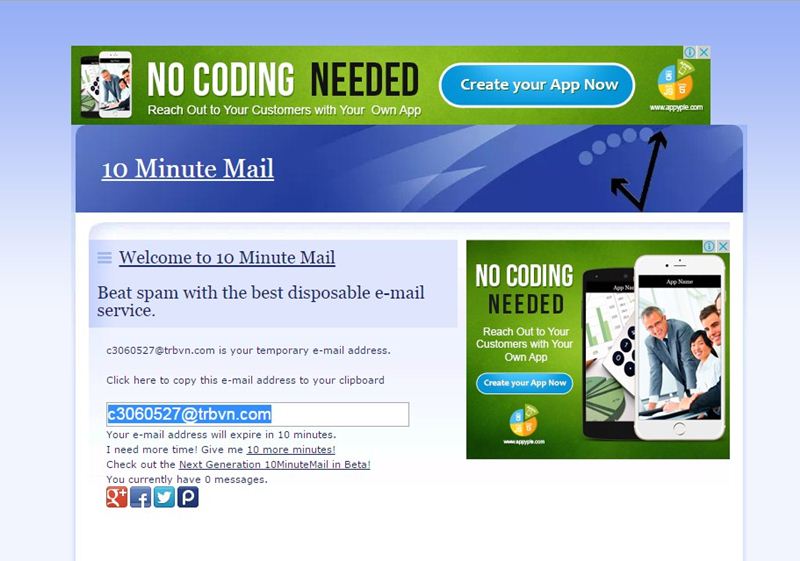
#1 10 Minute Mail

10 Minute Mail
10 Minute Mail
10 Minute Mail will provide you a temporary e-mail address. Any e-mails sent to that address will show automatically on the web page. You can read them, click on links, and even reply to them. The email address will expire after 10 minutes.

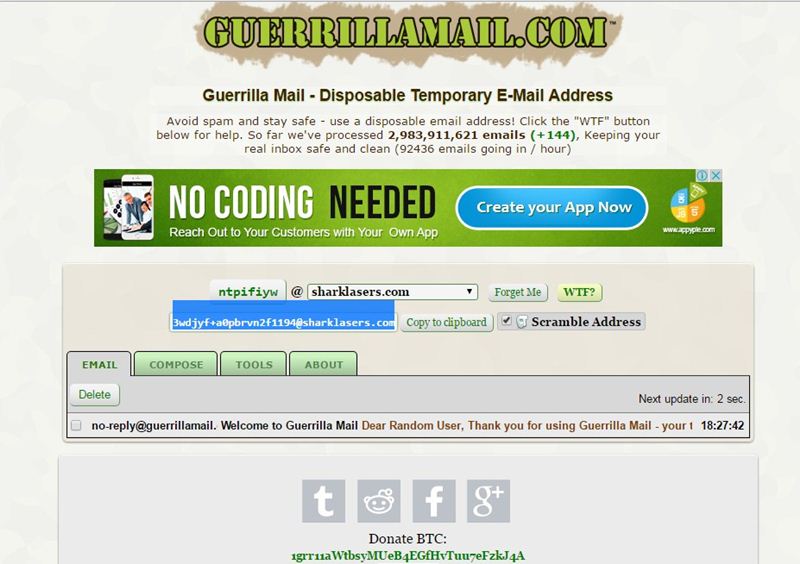
#2 GuerrillaMail

Guerrillamail
Guerrillamail
It is one of the most user-friendly ones out there, with this, you can get disposable email ID easily. You need to enter the details, and the fake email ID will be generated. Moreover, this also lets you send emails with attachment up to 150MB. You will be provided with a temporary email address which you can use to verify some websites which require the email address.

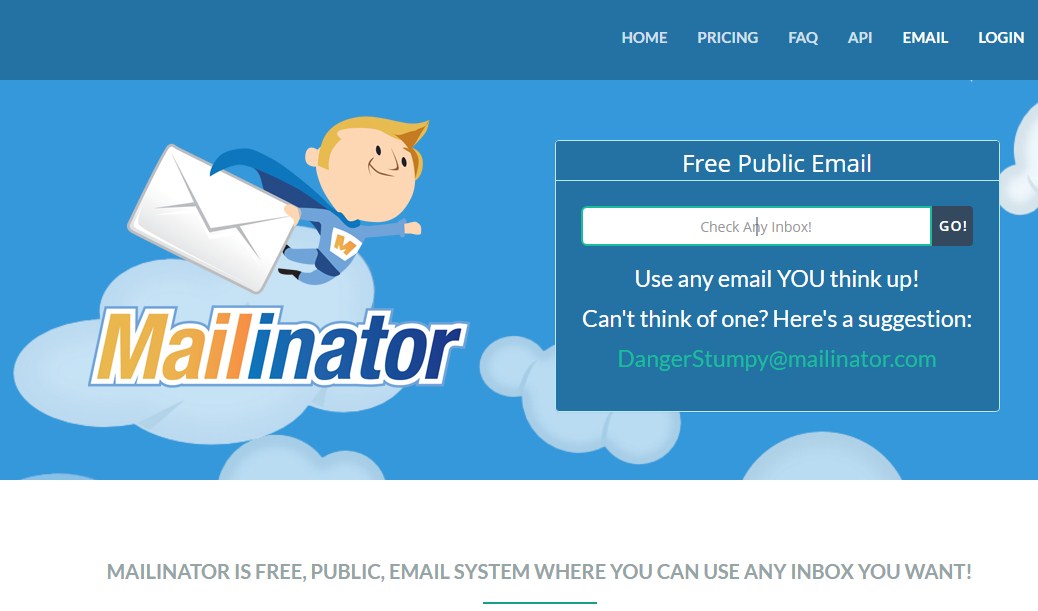
#3 Mailinator

Mailinator
Mailinator
Mailinator is a free, Public, Email System where you can use any inbox you want. You will be given a Mailinator address which you can use anytime a website asks for an email address. The public emails you will receive will be auto-deleted after few hours of receiving.

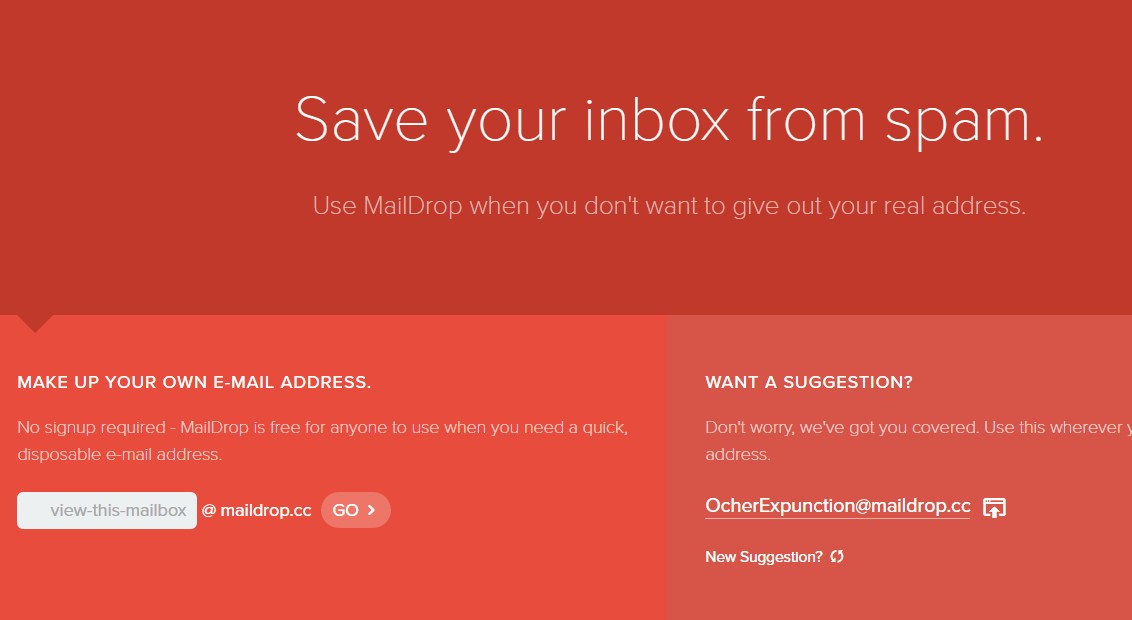
#4 MailDrop

MailDrop
MailDrop
Maildrop is a great idea when you want to sign up for a website but you are concerned that they might share your address with advertisers. MailDrop is powered by some of the spam filters created by Heluna, used in order to block almost all spam attempts before they even get to your MailDrop inbox. This works the same way like Mailinator in which you will be given a temporary Email address which you can use to verify sites etc.

#5 AirMail

AirMail
AirMail
AirMail is a free temporary email service, you are given a random email address you can use when registering to new websites or test-driving untrusted services. All emails received by AirMail servers are displayed automatically in your online browser inbox.
Related links